Retail groups
Accounts payable for retail groups with several Xero companies.
Goods received at the store, invoiced to head office, reconciled against the ledger and charged between companies. The same workflow FINIO runs for any group on Xero, with the questions a retail group asks.
For UK groups with several Xero companies, or one company with several sites kept apart by tracking categories. Not built for a single site running one company.
Structure
Check your company and site structure.
Several stores each trading as its own company, each with its own Xero organisation, connected to one FINIO account. Or one company with several stores kept apart by tracking categories. Not a single store running one company.
At the store
Connect goods received with supplier invoices.
The store photographs the delivery note. FINIO sets it against the supplier's invoice when that arrives at head office, and lists every difference before anything posts.
Placeholder example
- Ordered
- 24 units of a stocked line, for the Leeds store
- Signed for
- 20 units; 4 short on the delivery note
- Invoiced
- 24 units at £6.50, £156.00
- Held
- 4 units, £26.00, listed for finance with both documents
- Credit
- £26.00 expected, settled when the supplier's credit note arrives
Short and damaged
Handle shortages and credits.
A short delivery or a damaged case is a difference held on the day. The expected credit sits against the invoice until the supplier's credit note arrives and settles it.
Month-start
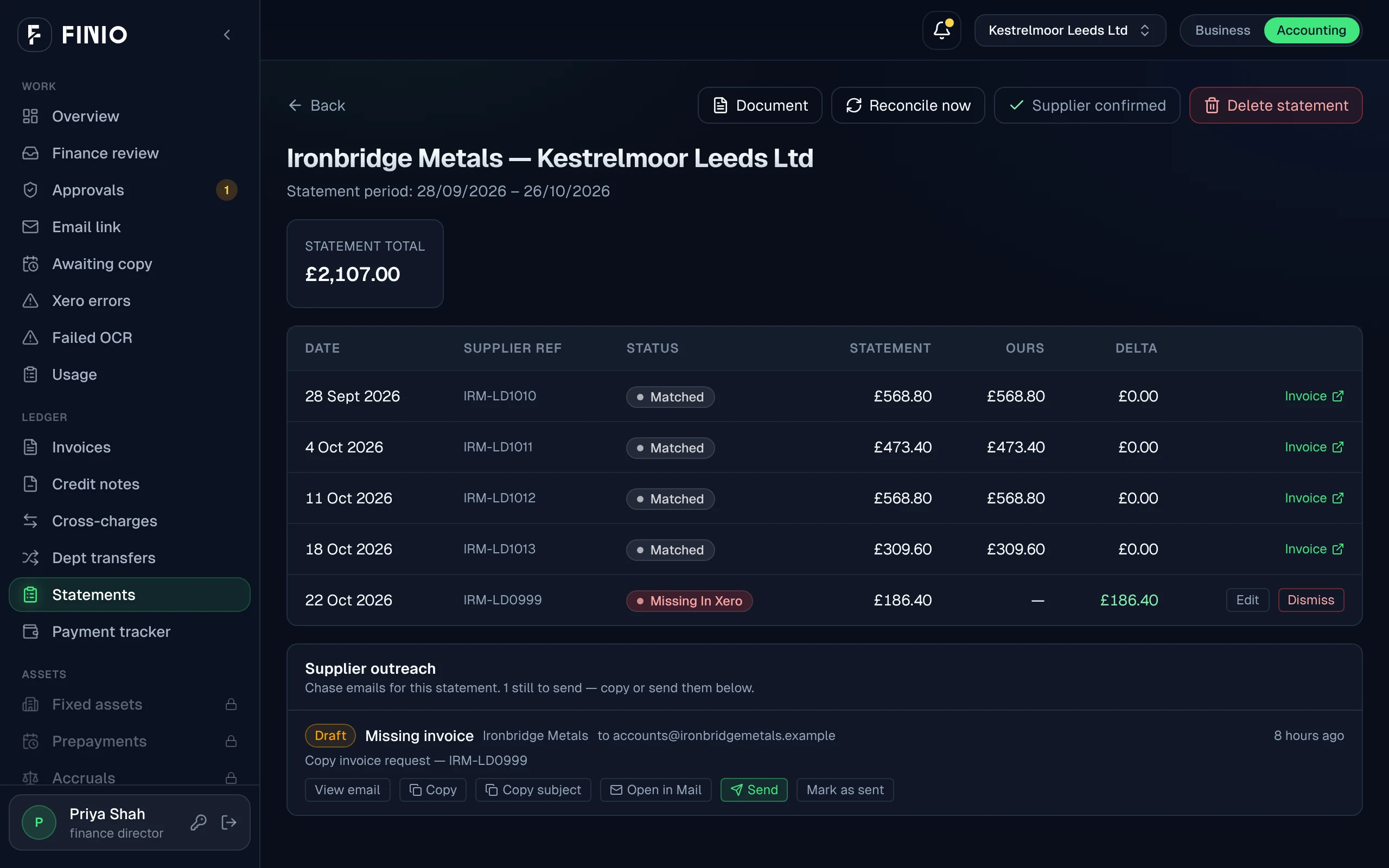
Reconcile suppliers across companies.
One supplier delivering to eight stores in four companies sends four statements. Each is matched against its company's ledger, the missing invoices listed and the chasing email drafted.
Across the group
Track group AP tasks.
- Where every supplier payment stands, across all companies, fed by the reconciliation
- Stock moved from one store's company to another, raised as a cross-charge and posted in both Xero files
- Costs moved between departments inside one company, with an approval behind each move
Connected
Your accounting and inbox connections.
Accounting
Xero
- Reads
- Chart of accounts, suppliers, bills and the ledger.
- Posts
- Authorised bills, credit notes and the journals for cross-charges and transfers.
Inbox
Microsoft Outlook
- Reads
- Invoices and statements that arrive in the finance inbox.
- Posts
- Nothing. Chasing emails are drafted for you to send.
Inbox
Google Mail
- Reads
- Invoices and statements that arrive in the finance inbox.
- Posts
- Nothing. Chasing emails are drafted for you to send.
Sage 50, QuickBooks, NetSuite and the till systems are planned, and listed as planned on the directory. An OAuth connection to Xero is not a Xero endorsement.
The Xero integration in detail →All connections, live and planned →Today
Implementation and current limits.
Connect each Xero organisation and send the first invoice; FINIO learns a year of history itself. Three things it does not do today:
- Planned
Till (POS) sales feeds
Square, Zettle, Lightspeed and EPOS Now. Until then site managers enter sales by hand.
- Planned
Ordinary supplier-bill approvals
Routing every supplier bill for approval before it posts. The approval loop exists for cross-charges and transfers today; keep your existing approval tool for ordinary bills until this ships.
- Planned
Paying suppliers from FINIO
FINIO shows what is ready to pay. The bank still makes the payment.
Questions
Retail group questions.
Does FINIO manage stock levels?
No. FINIO reads what was delivered and what was invoiced, and holds the difference. Stock management stays in your stock system; till connections are planned, not live.
Can each store be its own company?
Yes. Each company's Xero organisation connects to the one FINIO account, and a charge between two stores' companies posts in both files. Stores inside one company are kept apart by tracking category.
What if a store has no finance person?
Nobody at the store needs one. Whoever takes the delivery photographs the note; everything after that is finance's, at head office.
Fit
Check your fit.
FINIO fits if
Several stores, several Xero companies or tracking categories, deliveries signed for at the store and invoiced to head office.
It does not if
One store, one company; or the job you need is stock management, till integration or retail margin analysis, which are planned or outside FINIO.